
For years, the advertising world had two undisputed kings: Google and Meta. You wanted awareness? Meta. You wanted intent? Google. You handed over your budget, crossed your fingers, and hoped the algorithm liked you.
Then someone opened Blinkit to buy milk, and accidentally bought oats, a snack, and a cooking oil they didn't plan on. And a very different kind of king started quietly building its throne.
Welcome to quick commerce advertising. The most interesting media channel nobody's taking seriously enough yet.
These Are Not Delivery Apps Anymore
Let's be clear about what Blinkit, Zepto, and Swiggy Instamart actually are in 2026.
They're retail media platforms that also happen to deliver groceries in 10 minutes. Together, these three platforms are projected to generate nearly ₹4,900 crore in advertising revenue this year alone through sponsored listings, search placements, and premium visibility packages. Blinkit, Zepto, and Instamart together crossed ₹3,000 crore in ad revenue in FY25 and are on track to blow past that this year.
That's not grocery money. That's media money.
And brands are starting to treat it like that.
The Insight That Changes Everything
Here's what makes quick commerce ads fundamentally different from anything Google or Meta offers.
Google and Meta operate at the awareness and consideration stages of the funnel. You see an ad, maybe you remember the brand, maybe weeks later you buy something. It's a slow game with a long paper trail and a lot of "maybe."
Quick commerce is a different funnel entirely. The new objective isn't Top of Mind. It's Top of Cart.
When someone opens Blinkit, they are not browsing. They are buying. The intent is already there, all the brand has to do is show up at the right moment, in the right placement, for the right product. A sponsored listing at that exact second isn't an interruption. It's a suggestion at peak receptivity.
The gap between seeing and buying? Sometimes under two minutes.
Real Brands, Real Numbers
This isn't theoretical. Brands that figured this out early are seeing results that traditional digital campaigns struggle to match.
Marico has been running visibility campaigns on Blinkit timed around high-intent shopping moments, think evenings, weekends, restocking cycles, and converting discovery into purchase almost instantly. No awareness lag. No consideration phase.
Saffola Oats went further. They used SKU-level tracking to understand not just which campaign performed, but which variant of their product performed, in which city, at which time of day. That level of precision used to require expensive retail audits. Now it's a dashboard.
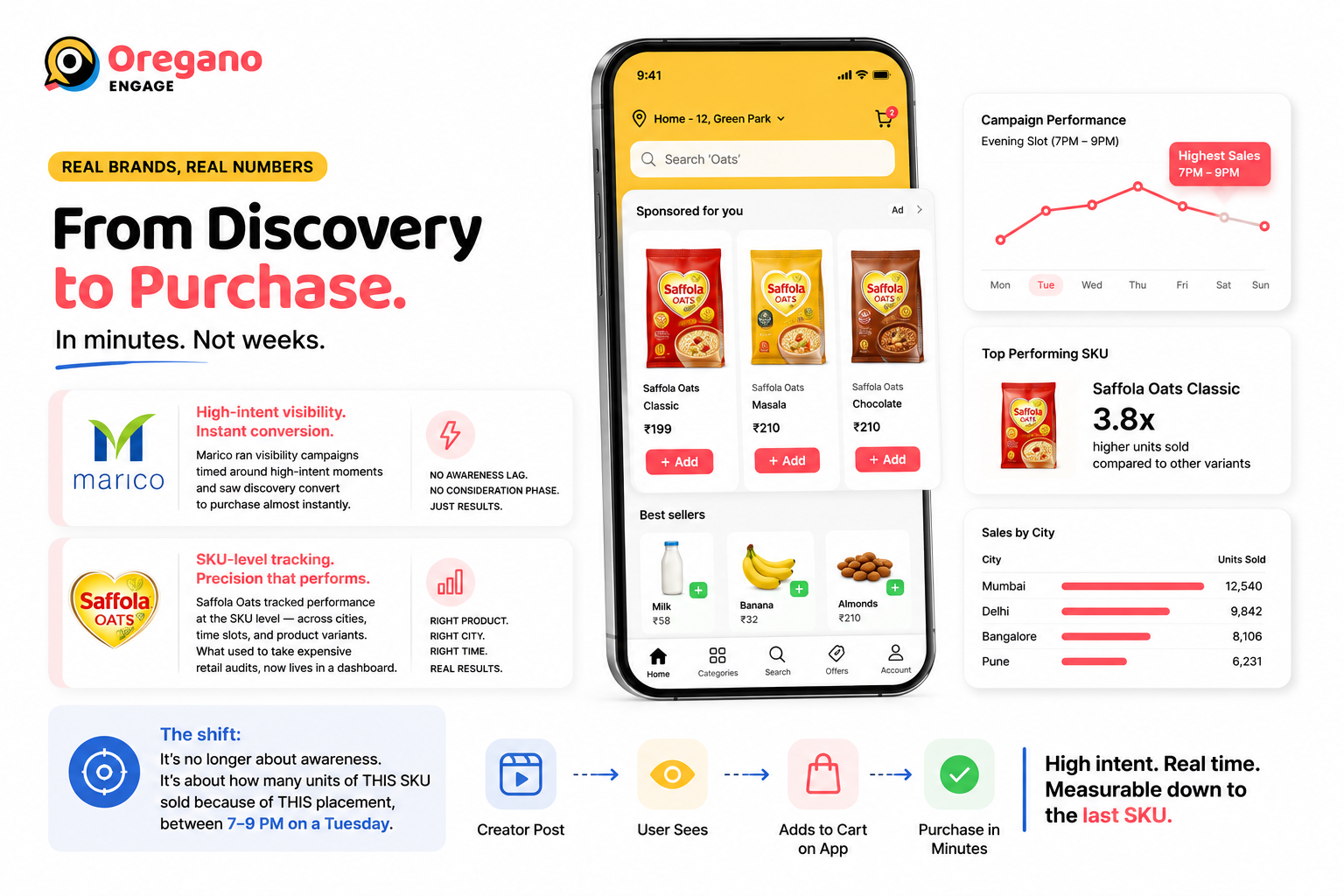
That's the shift. Instead of asking "did our campaign build awareness?", brands can now ask "how many units of this exact SKU sold because of this exact placement between 7 and 9 PM on a Tuesday?" And actually get an answer.
Where Influencer Marketing Plugs In
This is where things get genuinely exciting for the creator economy.
The classic influencer-to-purchase journey used to look like this: creator posts → audience watches → some percentage clicks a link in bio → a smaller percentage actually buys → brand celebrates or panics depending on the numbers.
Clunky. Leaky funnel. Hard to attribute.
Now imagine this instead: creator posts a reel featuring a product → viewer watches, makes a mental note → opens Zepto ten minutes later to order something → same product is featured at the top of the app → adds to cart → checkout.
Brands gain speed, visibility, and conversion through quick commerce, while platforms gain high-margin retail media revenue. When you layer creator content on top of that infrastructure, the whole funnel compresses dramatically. The creator creates desire. The app closes the deal. Almost immediately.
The gap between "I want that" and "I have that" is shrinking to minutes. That changes what influencer content needs to do — and what a successful campaign looks like.
The Catch (Because There's Always One)
Quick commerce advertising rewards brands that have their foundations sorted. The single fastest way to improve your Q-commerce ad ROI is to improve your product's organic ranking on the platform first, products with more reviews, higher ratings, and better sales velocity get better organic placement, which means ad spend works harder because organic and paid visibility compound.
In other words, you can't buy your way in if your product listing is weak. The platform's algorithm is brutally meritocratic. Ads amplify what's already working. They don't fix what isn't.
The brands winning in quick commerce in 2026 are not the ones spending the most. They're the ones who understood how the channel actually works before scaling anything.
The Bottom Line
The next big battle for advertising budgets isn't brewing between Google and Meta.
It's happening inside apps that promise to deliver your groceries in 10 minutes, and are quietly building one of the highest-intent advertising environments in the history of Indian digital marketing.
Quick commerce could account for as much as 70% of e-commerce sales for FMCG brands in the channel. For D2C brands, it means measurable performance and faster conversions. For marketers, a new high-intent channel that rewards precision. For creators, it means content is no longer just the beginning of an awareness journey — it's the first tap in a purchase that happens before the reel even ends.
If your brand isn't on these platforms yet, you're not missing a delivery app.
You're missing a media buy.
